Artisan Ink
September 21, 2026
A tattoo can look incredible on a screen.
Perfectly sharp lines. Tiny details. Delicate shading. An intricate design enlarged until it fills your phone.
But your tattoo isn't going to live on a screen.
It's going to live on you.
It will move when you move. It will bend around your arm, shoulder, leg or ribs. It will heal inside living skin. It will be exposed to sunlight. Your skin will change as you get older.
And a tattoo that looks beautiful on the day it's finished still needs to work years from now.
That's why one of the most important parts of good tattooing happens before the needle ever touches the skin.
It's deciding how a design needs to work on a body.
A Tattoo Is Not a Printed Image
One of the easiest mistakes to make when choosing a tattoo is thinking about the design as a flat image.
We understand why.
Most inspiration now comes from screens. You see a tattoo on Instagram or Pinterest, zoom in, save it and start imagining something similar.
But what you're looking at is usually a photograph of a tattoo, displayed on a flat screen and often considerably larger than the tattoo actually is.
Skin doesn't behave like paper.
It stretches. It moves. It has texture. Different parts of the body curve in different directions. And underneath that skin are muscles, joints and bone structures that affect how a tattoo sits and moves.
A good tattoo artist takes all of that into consideration.
The question isn't simply:
Does this design look good?
It's:
Will this design work as a tattoo, at this size, in this position, on this body?
Those are very different questions.
Placement Is Part of the Design
Placement shouldn't be an afterthought.
A tattoo designed for the forearm may need to be approached differently if you decide to put it on the shoulder, ribs or calf.
Why?
Because the shape of the body changes the way the artwork is seen.
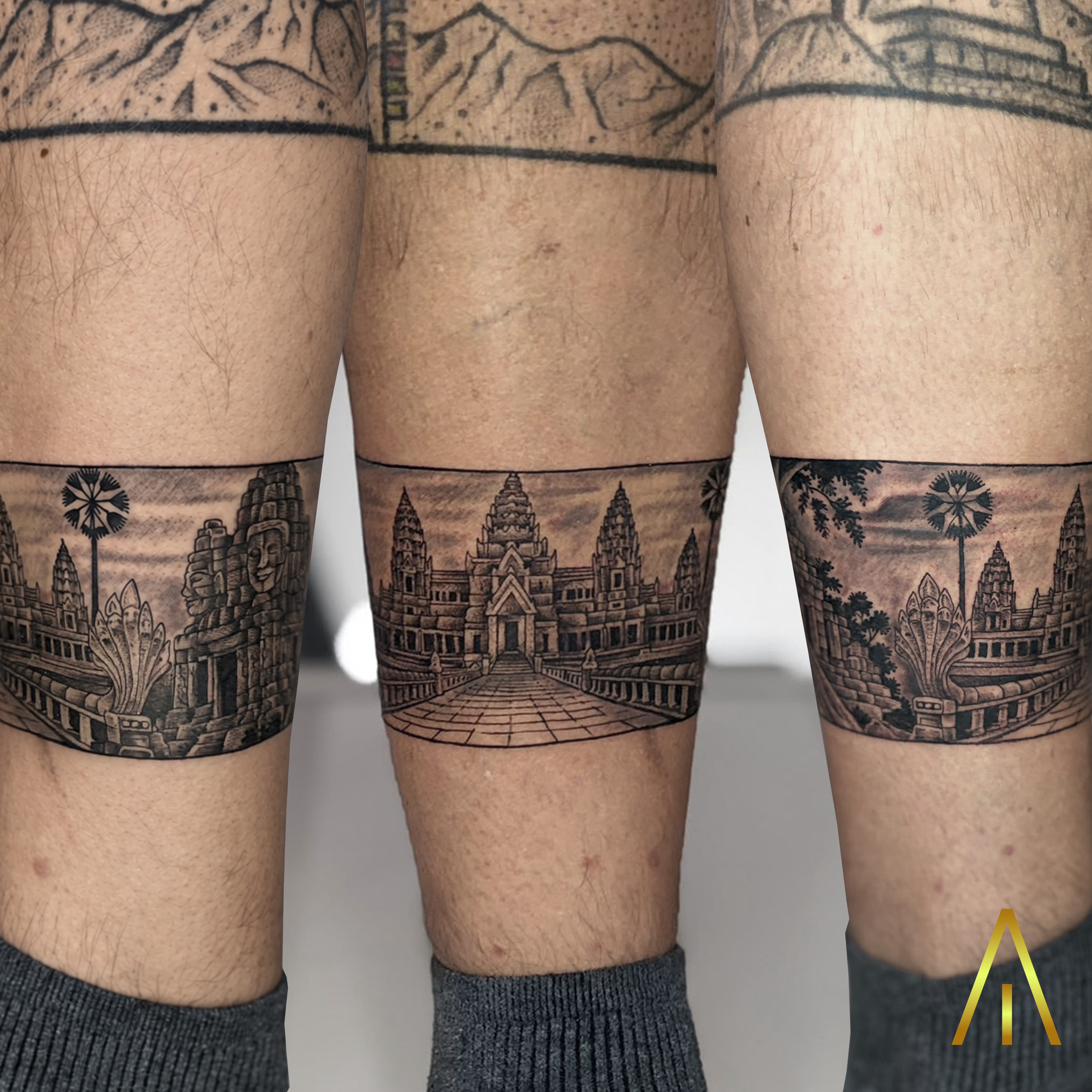
A well-designed tattoo can follow the natural lines of the body. It can complement the shape of a shoulder, flow along an arm or work with the movement of a leg.
This becomes particularly important with larger pieces.
Instead of simply placing an image onto the body, an experienced tattoo artist can use the body's existing shape as part of the composition.
Sometimes moving a stencil slightly, changing its angle or increasing its size can completely change the finished result.
It might seem like a small adjustment in the studio.
Five years later, it might be the reason the tattoo still works.
Why Your Artist Might Tell You to Go Bigger
This is a conversation tattoo artists have regularly.
A client loves a detailed design.
Then they want it significantly smaller.
Sometimes that works.
Sometimes it doesn't.
The problem isn't whether the artist can physically tattoo something that small. Modern tattooing equipment and techniques can produce extraordinary levels of detail.
The more important question is:
Should it be tattooed that small?
Every design needs enough space for its individual elements to remain readable.
Lines that sit extremely close together can become less distinct as a tattoo ages. Tiny areas of contrast may lose some of their definition. Details that looked separate when freshly tattooed can visually merge over time.
Giving a design enough space allows it to breathe.
So when your tattoo artist suggests making something larger, they're not necessarily trying to talk you into having more tattoo than you wanted.
They may simply be protecting the design.
Tattoos Change Because Skin Changes
There is no tattooing technique that freezes skin in time.
Tattoo pigment is placed within living tissue, and living tissue changes.
Skin renews itself. Bodies age. Weight can change. Sun exposure affects the skin. Tattoos naturally soften over the years.
That's normal.
A tattoo doesn't have to look identical twenty years later to have aged beautifully.
In fact, expecting it to look exactly like the photograph taken immediately after the appointment isn't realistic.
The aim is to create something that can change well.
That's where good design becomes important.
Contrast Matters
One of the things that helps a tattoo remain readable is contrast.
You need enough distinction between different elements of the design for the eye to understand what it's looking at.
That doesn't mean every tattoo needs enormous black outlines.
Different styles handle contrast differently.
A blackwork tattoo might create contrast through large areas of black and negative space. A realism piece might use variations between dark shadows and highlights. Japanese tattooing often uses strong composition, bold shapes and deliberate areas of open skin.
Fine-line work can be much more delicate, but the same basic consideration remains:
The design needs room to remain readable.
This is why an experienced artist isn't only thinking about how much detail they can put into a tattoo.
They're also thinking about which details actually need to be there.
Sometimes removing something makes the tattoo stronger.
More Detail Doesn't Always Mean a Better Tattoo
This is particularly relevant now because tattoo references are often viewed digitally.
You can zoom into an illustration and see every eyelash, strand of hair, scale, texture or tiny decorative element.
It's tempting to want all of it.
But there is a difference between detail that adds something to a tattoo and detail that simply fills space.
At the right scale, intricate detail can be spectacular.
At the wrong scale, it can compete with the overall design.
A tattoo should still make sense when somebody sees it from a normal distance.
Then, when they look closer, they can discover the finer details.
That's very different from creating something that only really works when photographed, enlarged and viewed on a phone.
Different Tattoo Styles Age Differently
There isn't one tattoo style that automatically ages better than everything else.
There are simply different design considerations.
Bold traditional work relies heavily on strong outlines and simple, readable shapes.
Blackwork often uses contrast and negative space.
Realism depends on careful tonal structure and sufficient scale.
Fine-line tattooing requires control, restraint and an understanding of how much detail the available space can realistically hold.
Japanese tattooing often works with the body on a much larger scale, using composition and flow to connect different elements.
The principles aren't identical, but the objective is similar:
Create a tattoo that works with the technique, placement and amount of space available.
That's part of the craft.
Healing Matters Too
The artist can create the tattoo, but what happens afterwards matters.
Following the aftercare instructions you're given allows the skin to heal properly and gives your tattoo the best possible start.
Long term, sun protection is particularly important.
UV exposure affects both your skin and tattoo pigment, and years of heavy sun exposure can contribute to fading and loss of definition.
That's especially worth considering here in Thailand, where strong sun is simply part of life.
Protecting your skin helps protect your tattoo.
What About Touch-Ups?
A touch-up can sometimes restore small areas that haven't healed as expected or refresh parts of an older tattoo.
But touch-ups aren't a substitute for good design.
If a tattoo was originally created with too much information packed into too little space, repeatedly adding more pigment isn't necessarily going to solve the underlying problem.
Ideally, longevity is considered before the tattoo is done.
That's why consultation matters.
The Best Tattoo Isn't Necessarily the Best Drawing
This distinction is important.
An incredible illustration isn't automatically an incredible tattoo.
Tattooing has its own rules.
A tattoo artist has to understand drawing, but they also need to understand skin, placement, scale, movement, healing, pigment, contrast and how all of those things interact.
Sometimes the design that works best on paper needs to change when it reaches the body.
A curve might need adjusting.
A detail might need simplifying.
An element may need moving.
The whole piece might need to become larger.
Those changes aren't compromises.
They're tattooing.
Think Beyond the Photograph
Of course we want your tattoo to look incredible when it's finished.
We want the photograph to look incredible too.
But the photograph isn't the finished purpose of the tattoo.
YOU ARE.
Your tattoo has to leave the studio with you.
It has to move through life with you.
So when you're choosing a design, deciding on placement or talking through size with your artist, it's worth thinking beyond how the tattoo will look in that first photograph.
Think about how it sits on your body.
How it moves.
How clearly it reads.
And how it has been designed to change over time.
Because a great tattoo shouldn't only be designed for the moment the camera comes out.
It should be designed for the years that come afterwards.
Planning a tattoo that lasts?
Start a conversation with Artisan Ink →