
Artisan Ink
August 5, 2026
Japanese tattoos are one of the most misunderstood traditions in tattooing. People see a dragon, a koi or a sleeve of cherry blossoms and assume each image is chosen because it looks striking. The reality is far more layered. Every element in a traditional Japanese tattoo has a purpose, a history and a relationship with the images around it. This guide is for anyone researching Japanese tattoos before committing to a design, written from the perspective of an artist who has spent years studying and applying this style.
What Are Japanese Tattoos?
Japanese tattoos, often referred to as Irezumi, are a distinct tradition of tattooing that developed in Japan over centuries. The term covers a broad family of imagery, from full body suits to small standalone pieces, but the defining characteristic is not the size or the placement. It is the visual language.
A Japanese tattoo is built from a specific set of motifs drawn from folklore, religion, nature and literature. Dragons, koi, tigers, demons, warriors, flowers and waves all belong to the same iconographic system. They are designed to work together, and when they are composed well, they read as a single unified image rather than a collection of separate tattoos.
This is what separates Japanese tattooing from many other styles. A traditional Japanese sleeve is not a gallery of favourite images. It is a composed scene, and the relationship between the figures, the background and the empty space is as important as the figures themselves.
The History of Irezumi
The roots of Japanese tattooing stretch back over a thousand years. Early references describe tattoos used as spiritual protection, marks of devotion and, in some periods, punishments that marked criminals. The practice carried a complex social weight long before it became associated with the decorative full-body suits we recognise today.
The modern tradition of large-scale Japanese tattooing took shape during the Edo period, roughly the 17th to 19th centuries. Woodblock print artists of the time produced vivid illustrations of heroes, demons and mythic beasts, and tattooists began translating those compositions onto skin. The visual conventions of the woodblock print, bold outlines, flat colour, flowing water and wind bars, became the foundation of the tattoo style.
During this period tattooing existed in a complicated space. It was admired by some as an art form and associated by others with criminality, partly because of the earlier use of penal tattooing. When Japan modernised in the late 19th century, the government banned tattooing along with a number of other traditional practices considered unsuitable for a modern nation. The ban pushed tattooing underground but did not erase it. Artists continued to work, often for foreign visitors who could legally receive tattoos, and the tradition survived.
The association with the Yakuza, the Japanese organised crime syndicates, developed during the 20th century. Full body suits became a marker of commitment and endurance within those circles, which reinforced the social stigma around visible tattoos in mainstream Japanese society. That stigma persists in Japan today, which is why many studios there still cover tattoos at hot springs, gyms and public baths. It is important to understand this context, because it shapes how the tradition developed and why discretion in placement still matters to many collectors.
Why Japanese Tattoos Are So Popular
Japanese tattoos have remained one of the most enduringly popular traditions in global tattooing for good reason. The style is built for the human body. The flowing compositions, the use of background elements like wind bars and water, and the way figures are designed to wrap around limbs all make Japanese tattoos sit on the body more naturally than many other styles.
The symbolism also gives the style a depth that purely aesthetic styles cannot match. A collector is not simply choosing an image that appeals to them. They are choosing a meaning, and often a personal narrative. This combination of visual strength and symbolic weight is rare.
The tradition is also remarkably adaptable. A client can wear a small cherry blossom on the wrist or a full back piece covering years of work, and both can be authentically Japanese in their approach. That range keeps the style relevant across very different collectors and budgets.
The Importance of Symbolism
Japanese tattoos are rarely random collections of images. They traditionally tell a complete story, and the meaning of each element is shaped by the elements placed alongside it. Understanding the individual symbols is the starting point, but the real skill in Japanese tattooing is in the relationships between them.
Below are the most common motifs, their traditional meanings, how those meanings have shifted in modern practice, and how each image typically works alongside others.
Dragon (Ryu)
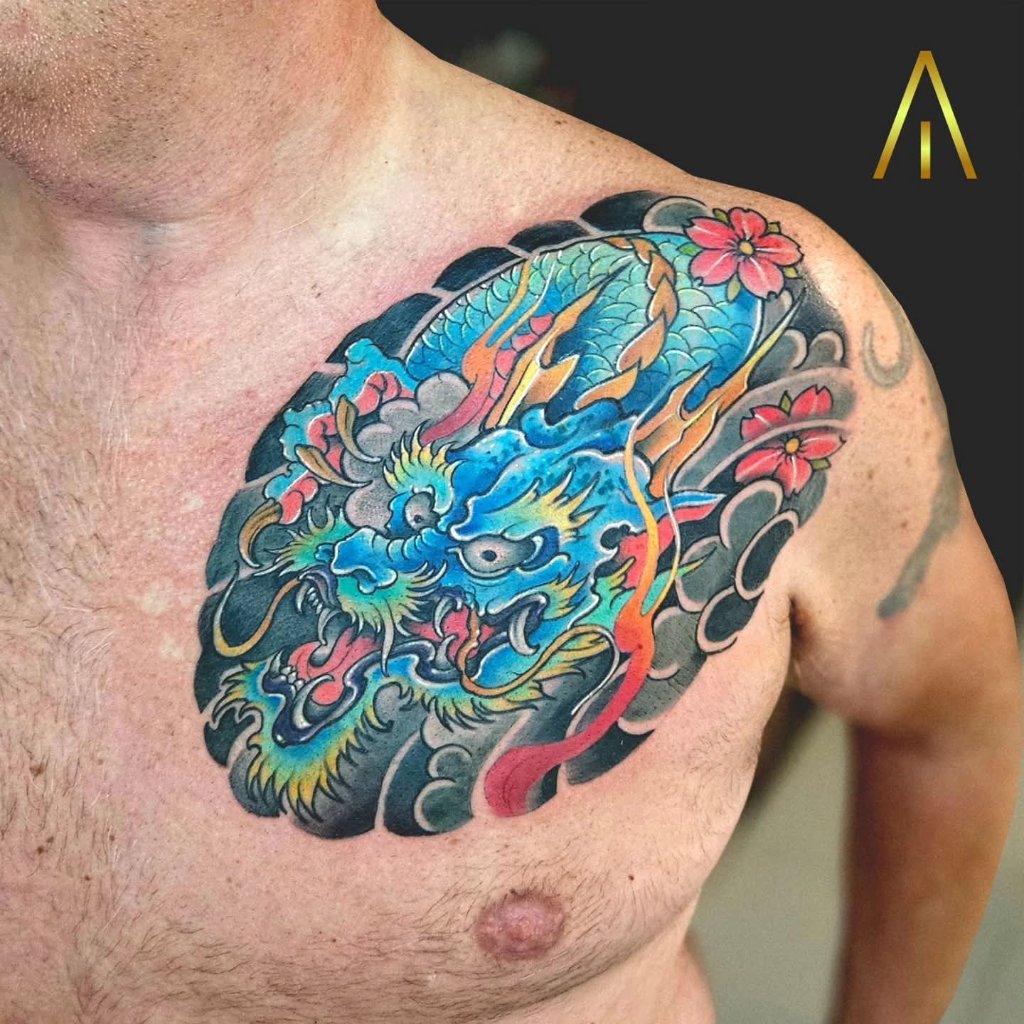
Traditional meaning: Wisdom, strength and protection. Unlike the dragons of European mythology, Japanese dragons are generally benevolent, water-associated beings rather than destructive ones.
Modern interpretation: The dragon remains a symbol of personal power and guardianship. Many collectors choose a dragon to mark a period of growth or to represent a protective presence.
How it works with other imagery: Dragons are almost always shown with clouds or waves. A dragon emerging from clouds suggests hidden power revealing itself, while a dragon among waves connects the creature to its watery origins.
Koi Fish
Traditional meaning: Perseverance and transformation. The koi is tied to the legend of a carp that swims upstream against the current of the Yellow River and, upon reaching the top, transforms into a dragon. It is a story of struggle rewarded.
Modern interpretation: The koi is chosen by people who have overcome something significant or who are in the middle of that struggle. It is one of the most personally meaningful motifs in the tradition.
How it works with other imagery: A koi swimming upstream beneath storm clouds reads as a battle against adversity. A koi in calm water can suggest achievement and peace after the struggle. The direction the koi faces and the water around it change the message.
Phoenix (Hou-ou)
Traditional meaning: Rebirth, renewal and the arrival of peace. The phoenix appears in Japanese mythology as a rare, auspicious creature that descends in times of harmony.
Modern interpretation: The phoenix is strongly associated with starting over, rebuilding after loss, or marking a major life transition.
How it works with other imagery: Paired with cherry blossoms, a phoenix can speak to the beauty and brevity of new beginnings. Paired with fire motifs, it leans into the theme of destruction and renewal.
Tiger
Traditional meaning: Courage, strength and protection against evil. The tiger is often shown as a guardian figure, particularly against illness and misfortune.
Modern interpretation: The tiger is chosen for personal courage and resilience. It is also a popular choice for protection, in both a literal and spiritual sense.
How it works with other imagery: Tigers are frequently shown with bamboo, which bends but does not break, reinforcing the theme of strength under pressure. A tiger with wind bars suggests movement and vigilance.
Snake (Hebi)
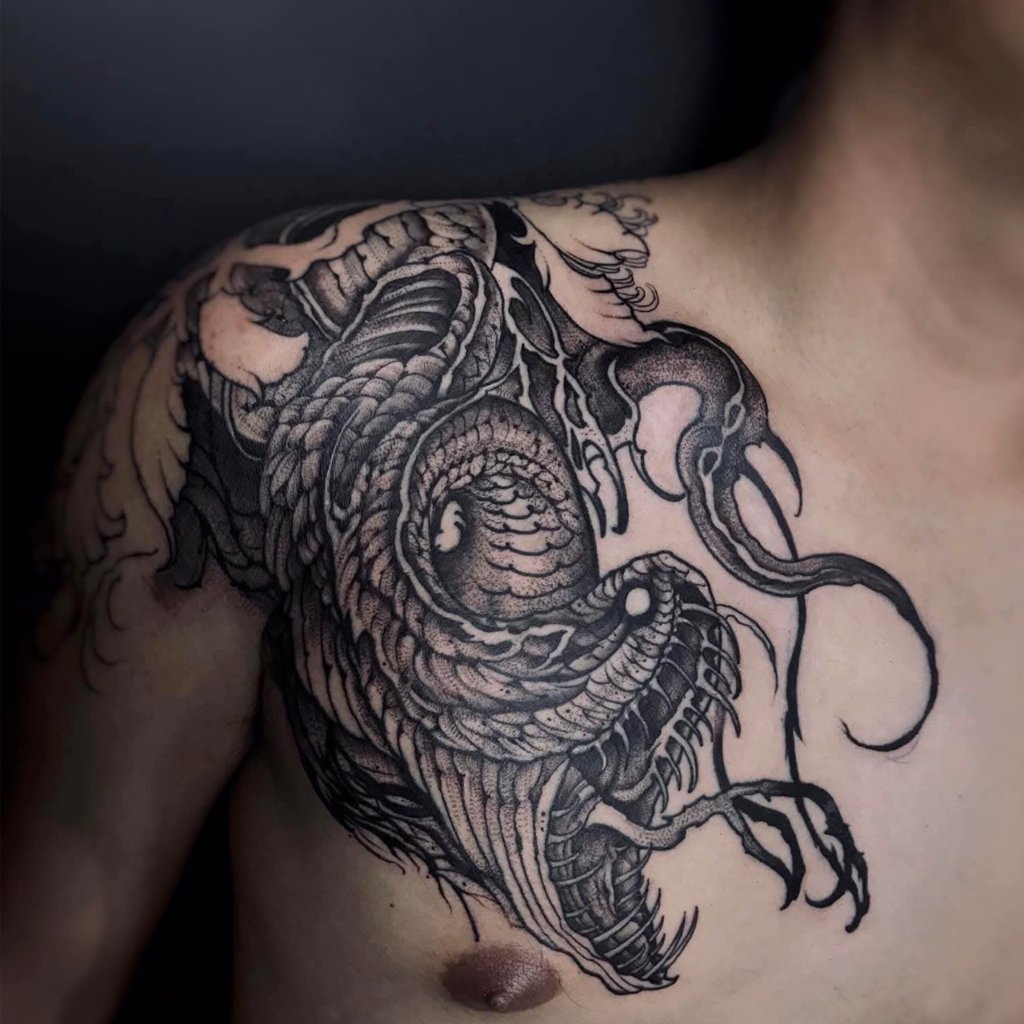
Traditional meaning: Protection, prophecy and rebirth through shedding of the skin. The snake is a complex symbol in Japanese culture, regarded with both caution and respect.
Modern interpretation: The snake often represents transformation and the shedding of an old self. It can also serve as a protective figure.
How it works with other imagery: Snakes are commonly wrapped around a sword or paired with peonies. The combination of a snake and a peony, a flower associated with wealth and honour, is a classic pairing that balances danger and beauty.
Oni (Demon)
Traditional meaning: Oni are fearsome creatures from Japanese folklore, often associated with punishment of the wicked and protection against misfortune. They are not purely evil in the Western sense; they occupy a more complicated moral space.
Modern interpretation: An Oni can represent facing one's fears, acknowledging a darker side, or serving as a guardian against harm.
How it works with other imagery: Oni are often shown with weapons, chains or flames. They can be paired with Buddhist imagery to suggest the taming of destructive impulses.
Samurai
Traditional meaning: The warrior class of feudal Japan, the samurai represent duty, loyalty, honour and the willingness to face death with composure. They are drawn from both historical figures and literary heroes.
Modern interpretation: A samurai tattoo often marks a personal code, a commitment to discipline, or respect for a particular value system.
How it works with other imagery: Samurai are frequently shown in battle scenes, with cherry blossoms falling around them. The falling blossoms, beautiful and brief, echo the samurai ideal of living fully and dying well.
Geisha
Traditional meaning: The geisha represents artistry, grace and dedication to craft. She is a figure of cultural refinement, trained in music, dance and conversation.
Modern interpretation: A geisha tattoo can honour beauty, artistry or a significant relationship. She is often chosen as a tribute or a symbol of appreciation for feminine strength.
How it works with other imagery: Geisha are commonly paired with cherry blossoms, fans or maple leaves, which frame the figure and reinforce themes of beauty and transience.
Cherry Blossom (Sakura)
Traditional meaning: The impermanence of life. Cherry blossoms bloom brilliantly and fall quickly, making them a meditation on mortality and the value of the present moment.
Modern interpretation: Sakura remains one of the most chosen motifs for its reminder to live fully and appreciate what is fleeting.
How it works with other imagery: Cherry blossoms are a background and framing element as much as a subject. They soften harder imagery and tie a composition together.
Peony (Botan)
Traditional meaning: Wealth, honour and prosperity. The peony is sometimes called the king of flowers in Japanese art.
Modern interpretation: The peony is chosen for its associations with good fortune and its sheer visual richness.
How it works with other imagery: Peonies are the classic companion to the lion or the snake, balancing ferocity with beauty. They also fill background space with elegant structure.
Lotus
Traditional meaning: Purity and spiritual awakening. The lotus rises from muddy water to bloom cleanly, making it a powerful Buddhist symbol.
Modern interpretation: The lotus is chosen to mark spiritual growth, recovery or a clean break from a difficult past.
How it works with other imagery: The lotus sits naturally with water and with Buddhist figures. It grounds a composition with a calm, centred presence.
Maple Leaves (Momiji)
Traditional meaning: The passing of time and the changing of seasons. Maple leaves signal autumn and the natural close of a cycle.
Modern interpretation: Maple leaves often mark a transition or the end of a chapter. They bring warmth and movement to a composition.
How it works with other imagery: Maple leaves are frequently shown falling in wind, carrying the eye through a sleeve and connecting separate figures into one flowing scene.
Waves
Traditional meaning: The power and unpredictability of nature. Waves in Japanese art are rarely static; they are shown in motion, cresting and breaking.
Modern interpretation: Waves can represent the forces a person has navigated, or the constant change of life.
How it works with other imagery: Waves are a foundational background element. They carry koi, dragons and sea creatures, and they fill the negative space between figures so the eye never lands on bare skin.
Clouds and Wind Bars
Traditional meaning: The unseen forces that shape the visible world. Wind bars and clouds frame the main subjects and create the sense that the tattoo is a window onto a larger scene.
Modern interpretation: These elements remain primarily structural. They are what make a Japanese tattoo read as a single composition rather than a patchwork.
How it works with other imagery: Clouds and wind bars are the connective tissue of a Japanese sleeve. They allow an artist to transition between subjects, hide edges and direct the viewer's eye.
Japanese Tattoos Tell Stories, Not Just Symbols
One of the biggest misunderstandings about Japanese tattoos is the belief that each image exists independently. A client will sometimes arrive with a list of symbols they like, a dragon here, a koi there, a cherry blossom to fill a gap, expecting them to be placed as separate pieces. In the traditional Japanese approach, that misses the point entirely.
Japanese tattooing is a storytelling tradition. The artist combines multiple elements to create a visual narrative, and the meaning of the tattoo emerges from how those elements interact. A single image can say something, but a composed scene says something far more specific.
Consider a koi swimming upstream beneath heavy storm clouds. On its own, the koi speaks to perseverance. Add the storm, and the piece becomes about a specific struggle, the journey through adversity toward transformation. Now place a dragon above those clouds, looking down. The dragon represents the wisdom earned through that journey, the form the koi is striving to become. Read together, the three elements tell a complete story of hardship, endurance and the reward of growth. None of them means the same thing in isolation.
Or take a phoenix surrounded by falling cherry blossoms. The phoenix alone is rebirth. The cherry blossoms alone are the brevity of beauty. Combined, the piece speaks to rebuilding a life after loss, and the recognition that the new life is precious precisely because it is fragile. That is a very different statement from either symbol on its own.
A tiger standing in bamboo tells of strength that yields rather than breaks. A samurai beneath falling cherry blossoms meditates on living well in the knowledge of death. A snake coiled among peonies balances danger and beauty, the idea that the things that protect us are often the things that require the most respect.
This storytelling tradition is what makes Japanese tattooing unique. Other styles can be beautiful, technically excellent and personally meaningful, but few are built around narrative composition in the way Japanese tattoos are. When a client understands this, the consultation changes. The question stops being "which images do I like?" and becomes "what story do I want this tattoo to tell?" That is the question a Japanese tattoo artist is trained to answer, and it is where the real work begins.
Traditional Japanese vs Neo Japanese
Within the broad tradition of Japanese tattooing, two main approaches exist today, and understanding the difference helps a collector choose the right direction.
Traditional Japanese, sometimes called classic Irezumi, follows the visual conventions established by the woodblock print artists. Outlines are bold and confident. Colour is laid in flat, saturated fields rather than soft gradients. The palette is limited but powerful, with deep reds, blues, greens and yellows. Background elements, wind bars, waves and clouds, are as carefully rendered as the main figures. The overall effect is graphic, strong and built to last.
Neo Japanese takes the same subject matter and loosens the rules. Artists working in this direction may use softer shading, wider colour palettes, more realistic rendering of figures, or combine Japanese motifs with elements from other traditions. The storytelling often remains, but the visual language is more flexible.
The differences show up in colour, composition and subject matter. Traditional work uses a restrained palette and flat colour; neo work may introduce pastels, muted tones or painterly shading. Traditional composition is dense and structured, with every area of skin accounted for; neo composition may leave more open space or break the frame. Traditional subject matter stays close to the classical motifs; neo work may reinterpret those motifs or introduce new ones.
Neither approach is superior. Traditional work has a durability and a formality that suits collectors who want a piece that will read clearly for decades. Neo work offers more room for personal interpretation and contemporary aesthetics. The right choice depends on the collector's taste, their body and the story they want to tell.
Planning a Japanese Sleeve
A Japanese sleeve is one of the most rewarding projects in tattooing, and one of the most demanding. Because the tradition is built on composition, a sleeve cannot be assembled piece by piece without a plan. The best sleeves are designed as a whole, even if they are tattooed over months or years.
Body flow is the first consideration. A Japanese sleeve is designed to move with the body. Figures follow the natural twist of the arm, water flows in the direction the arm moves, and wind bars wrap so the composition reads correctly from every angle. An experienced artist maps the arm before drawing a single figure.
Composition is about the relationship between the main subjects and everything around them. In a Japanese sleeve, the background is not filler. The waves, clouds and wind bars are what make the main figures feel embedded in a scene rather than stuck onto the skin. Planning the composition means deciding where the eye should travel and how the figures connect.
Negative space is the skin left uncovered, and in Japanese tattooing it is as intentional as the ink. Well-placed negative space gives the eye room to rest and lets the inked areas read more strongly. A sleeve that fills every inch often looks cluttered; a sleeve that uses negative space deliberately looks balanced.
Background elements tie the sleeve together. Wind bars, clouds, water and floral backgrounds are the connective tissue. They allow the artist to transition from one subject to another without hard edges, and they carry the viewer's eye through the full composition.
Future expansion is a practical concern. Many collectors begin with a single piece and later decide to build it into a sleeve. If the first piece is designed in isolation, expanding it can mean compromising the original work or covering it entirely. If the first piece is designed with the eventual sleeve in mind, expansion becomes a natural continuation. This is why experienced artists plan entire sleeves rather than individual tattoos, even when the client intends to start small.
Colour vs Black & Grey
Japanese tattoos can be executed in full colour or in black and grey, and each approach has its strengths.
Colour is the traditional choice and remains the most common. Saturated reds, blues and greens read powerfully on the skin and give Japanese imagery its characteristic impact. Colour suits collectors who want the full visual drama of the tradition and who are willing to commit to the larger sessions that colour work requires. The main consideration is longevity. Colour fades more slowly when the ink is packed in well and the piece is protected from sun, but it does soften over decades. A well-executed colour Japanese tattoo holds its shape and readability far longer than its brightness.
Black and grey Japanese work is a more recent development but has grown into a respected approach in its own right. Without colour, the composition relies entirely on line, contrast and shading. This can suit collectors who prefer a quieter aesthetic, who work in environments where visible colour is impractical, or who want a piece that ages more predictably. Black and grey tends to hold its readability longer than colour because there is less pigment to fade.
Neither choice is universally better. Colour suits those who want impact and tradition; black and grey suits those who want subtlety and longevity. A good artist can advise on which approach will serve the specific design and the collector's skin.
Choosing the Right Artist
Japanese tattooing places demands on an artist that not every tattooer is equipped to meet. The style requires a specific set of skills, and choosing the right artist is the single most important decision in the process.
Composition is the foundation. A Japanese tattoo is judged by how the elements relate to each other and to the body. An artist who understands Japanese composition can place figures so they flow with the limb, use background to connect subjects and leave negative space where it serves the design. This skill takes years to develop and is visible in the artist's portfolio.
Line work in Japanese tattooing needs to be confident and consistent. The bold outlines of traditional Japanese imagery are structural, not decorative. Weak or inconsistent lines undermine the whole composition. Look for clean, unwavering linework in an artist's healed work, not just their fresh pieces.
Colour saturation matters for collectors choosing colour work. Japanese colour needs to be packed in densely to hold its richness over time. An artist who lays colour too lightly produces work that looks good on the day and fades to a wash within a few years. Healed photos are the only reliable evidence of saturation.
Understanding of traditional design separates a tattooer who can draw Japanese motifs from one who understands the tradition. The rules of combination, the direction figures face, the relationship between subjects and backgrounds, the meaning carried by composition, these are learned through study, not instinct. Ask an artist about the story behind a piece in their portfolio. A thoughtful answer is a good sign.
Designing for the human body is the final test. A Japanese tattoo that looks perfect on paper can fail on skin if the artist has not accounted for how the body moves, how the muscle changes shape and how the piece will be viewed from different angles. The best artists design in three dimensions, working with the body rather than around it.
None of this is about criticising other artists. Most tattooers work hard and produce honest work. Japanese tattooing is simply a specialised discipline, and a collector investing years and significant cost in a sleeve deserves an artist whose training and portfolio match the project.
Frequently Asked Questions
What does a Japanese tattoo mean?
The meaning depends on the specific imagery and how the elements are combined. A single motif like a koi or a dragon carries a traditional meaning, but in a composed Japanese tattoo the meaning comes from the story the elements tell together. This is why two people with the same symbol can have very different tattoos.
How long does a Japanese sleeve take?
A full Japanese sleeve is a long-term project. Most require multiple full-day sessions spread over months or years, depending on the complexity, the colour density and how the skin heals. A realistic estimate is anywhere from six months to several years for a complete sleeve done properly.
Do Japanese tattoos have to be large?
No. While the tradition is known for large-scale work, the same visual principles apply to smaller pieces. A single koi, a dragon or a cherry blossom branch can be authentically Japanese in approach. The size should suit the design and the collector's commitment, not a rule about scale.
Is it disrespectful to get a Japanese tattoo if I am not Japanese?
The tradition has a complicated history, and views differ. Most artists who work in the Japanese tradition do so out of respect for the craft and the symbolism. The respectful approach is to understand the meaning of what you are wearing, to choose an artist who understands the tradition, and to treat the imagery as more than decoration. Avoid motifs with specific cultural or criminal significance that you do not intend.
Can I add to a Japanese tattoo later?
Often, yes, if the original piece was designed with expansion in mind. This is one of the strongest reasons to plan a sleeve before starting. If the first piece was placed and composed in isolation, adding to it can be difficult. If it was designed as the beginning of a larger composition, expansion is straightforward.
Do Japanese tattoos hurt more than other styles?
The sensation is the same as any tattoo of similar size and placement. Japanese sleeves tend to involve longer sessions and can cover more sensitive areas, which makes the overall experience more demanding, but the pain per inch is no different from any other style.
How do I choose between colour and black and grey?
Colour gives the traditional impact and drama; black and grey offers subtlety and tends to age more predictably. Your skin tone, your lifestyle and how visible the tattoo will be all play a part. An experienced artist can show you healed examples of both and help you decide.
Can I get a Japanese tattoo in Thailand?
Yes. There are skilled artists working in the Japanese tradition across Thailand, including in Chiang Mai. The same criteria apply anywhere: look at healed work, ask about the meaning behind the designs, and choose an artist whose composition and line work you trust.
How do I know if an artist is right for a Japanese sleeve?
Look at their portfolio, specifically healed work. Check for consistent line work, saturated colour that holds, and compositions that flow with the body. Ask how they plan sleeves and whether they design with future expansion in mind. Their answers tell you whether they approach the tradition as a craft or as a style to imitate.
Conclusion
Japanese tattooing is a tradition built on meaning, composition and storytelling. The individual symbols, the dragons, koi, cherry blossoms and waves, are the vocabulary, but the real work happens in how they are combined. A Japanese tattoo is not a collection of attractive images. It is a scene, a narrative and a statement, composed to sit on the body and to carry a story for a lifetime.
If you are researching Japanese tattoos, the most useful question you can bring to a consultation is not which images you find appealing, but what story you want your tattoo to tell. The symbols will follow from that. An experienced artist can listen to your story, suggest imagery that carries the right meaning, and compose those elements into a piece that reads as a unified whole rather than a set of decorations.
That conversation is where a Japanese tattoo begins. If you would like to explore what your story could look like on skin, you are welcome to book a consultation with us at Artisan Ink Tattoo Studio. We will take the time to understand what you want to say, and help you design a piece that says it properly.
Plan your Japanese tattoo
Book a consultation with Artisan Ink